After nine years, I finally gave up on the Facebook. It wasn't a rash decision. I didn't have a fight and run. I'm not hiding from some personal drama. What I know is this, Facebook became a cesspool for me. Perhaps because I work at an agricultural biotech company and also love politics, my newsfeed was overloaded with piss and vinegar. I would be hard pressed to come up with two other areas where the discourse rarely rises out of petty name-calling and sewer-like "dialog." With each passing day, I would refresh my newsfeed and feel more and more overwhelmed. More and more I found myself looking at Facebook and asking myself, what the hell is the point?
A little over two weeks ago, I deactivated my account. "Do you really want to deactivate your account? Perhaps you should just logoff instead." No, I really want to do this. I clicked yes, and just like that my existence on Facebook became more nebulous. I consciously did not delete my account. Much of my life over the last several years is documented there and I don't want to let that all go - too many photos, my kids growing up, the break up of my marriage if you pay close enough attention, and the blossoming and maturing of my life and outlook over the last couple of years. I decided to leave all of that in its digital box, tightly sealed up until a time where I can open it up without the burden of feeling overwhelmed by the ugliness of the world. I also removed further temptation by deleting its app from my phone.
I suppose my post-Facebook experience was not unlike withdrawals from any other kind of addiction. Let's face it, Facebook was my digital crack. I know the chemistry in my brain was reacting to every "like" or notification or comment just like any other reward system. The first day I found myself picking up my phone and scrolling only to come up empty. I wondered what my friends were saying. I clicked on the bookmark only to get a logon screen, which, if activated would reactivate my account and plunge me right back in. Perhaps the hardest was that weekend. We went to visit my daughter who has just moved away for college. When I travel, I take many photos of my trip and post them all on Facebook in their own little neat album. This trip was no different, except I had nowhere to share the photos. No place where the rest of my family could see my daughter in her new city. So I left them on my phone.
But coming back home, I did not feel I was missing out on anything by not seeing the world through the lens of Facebook. I followed news via Twitter, which I find less depressing than Facebook. I found that I had more time to live in the world that surrounds me, not the digital world. I read more, books for pleasure, and technical literature in my field. I took up painting and have finished my first two small works, both scenes from my trip to Paris last fall with SK. Last weekend I went to visit SK in NYC. As usual, I took photos around the city, capturing the off the path scenes of life that are new to a Texas boy. I did catch myself thinking a few times that it would be cool to share them, but I did not fret about it. In fact, I have found that this week I have not fretted about social media at all. I have felt a calm about things and have discovered a clearer head with which to think about the world around me, the life I lead and the life I desire.
I do miss things about Facebook. I live apart from all of my family. Facebook was a place that allowed us to connect and to keep up with our lives apart. Given that I overshared, they probably miss more than I. I miss the happenings of a few of my closest friends. I know I am missing some cool links to interesting things in the corners of the internet that I no longer frequent. But I am also finding better ways to connect with those closest to me, ways that seem more intimate and healthier than wading through the noise of social media. I am sure that at some point I will reactivate my account and probably filter everything to a more manageable level. But for now, this is good. This is right.
Saturday, September 17, 2016

Monday, August 08, 2016
Entropy Monday - transitions edition
Yesterday my boy played in his 3rd all-star game in 4 years. This year he won the skills competition for the fastest runner. This was his finest season to date in his young baseball career. Last year was probably his greatest improvement as a baseball player, he actually became a baseball player - focused, a student of how to play the game. This year he really worked on becoming a better player. We bought him a hitting net and he hit at least 100 pitches off a tee almost every day during the season. It paid off with a .815 batting average over the season - likely a 400 point improvement over last season (he didn't keep his stats last season, another change this year). His immediate goal is to make the high school team next spring. Longer term, he wants to play in college and perhaps the MLB. Lofty goals, but he knows hard work will pay off now.
My daughter leaves for college in a couple of weeks. She joins the Conservatory of Performing Arts at Point Park University. She has become such a talented performer the last 5 years. Getting into the CoPA is as hard as getting an NIH grant these days. She has dreams of making it to NYC and Broadway and PPU has an excellent reputation in getting their students there. I know she's going to be great. I don't know exactly how I am going to feel about her being gone. The past year because of all of her school and work activities, I have not seen much of her. And yet, her presence is still felt even when we only see her for a few minutes in a day. I guess I haven't thought much about it until now. The times goes by so damned fast.
I have fallen in love with NYC. Five years ago I would find uttering those words unfathomable. My first visit to see SK, she took me to many of the tourist sites - Empire State, Times Square, Broadway, Central Park - and they were cool. But most visits since, I have gone to see her and not "visit the city." Of course we have seen the city, but the side of the city that's out of the way. I see the NYC that a resident sees - the neighborhoods, the events, the crowded subway. Granted, I am there "on vacation" but still I feel like I am getting an authentic experience and frankly, I love it. I could see myself living there at some point. As SK points out, it's great if you're rich and you can throw money back at all the problems the city sends your way. I highly doubt that will ever be my circumstance. But NYC, you're on my radar.
That's probably enough randomness for one day. I'm off to read a paper on the van der Waals interactions that determine the unique properties of water.
My daughter leaves for college in a couple of weeks. She joins the Conservatory of Performing Arts at Point Park University. She has become such a talented performer the last 5 years. Getting into the CoPA is as hard as getting an NIH grant these days. She has dreams of making it to NYC and Broadway and PPU has an excellent reputation in getting their students there. I know she's going to be great. I don't know exactly how I am going to feel about her being gone. The past year because of all of her school and work activities, I have not seen much of her. And yet, her presence is still felt even when we only see her for a few minutes in a day. I guess I haven't thought much about it until now. The times goes by so damned fast.
I have fallen in love with NYC. Five years ago I would find uttering those words unfathomable. My first visit to see SK, she took me to many of the tourist sites - Empire State, Times Square, Broadway, Central Park - and they were cool. But most visits since, I have gone to see her and not "visit the city." Of course we have seen the city, but the side of the city that's out of the way. I see the NYC that a resident sees - the neighborhoods, the events, the crowded subway. Granted, I am there "on vacation" but still I feel like I am getting an authentic experience and frankly, I love it. I could see myself living there at some point. As SK points out, it's great if you're rich and you can throw money back at all the problems the city sends your way. I highly doubt that will ever be my circumstance. But NYC, you're on my radar.
That's probably enough randomness for one day. I'm off to read a paper on the van der Waals interactions that determine the unique properties of water.
Wednesday, May 20, 2015
His name is Slatts
I first "met" him in September of 2005, the 24th to be exact. I know this because we both blogged at LiveJournal and that's the day he first left a comment on my blog. His comment had nothing to do with my entry, but was in response to the "Current music - Bob Dylan Desolation Row" tag at the end of the blog.
Our friendship continued to grow over our shared passion for music. But Slatts lived in Massachusetts and so we also bonded over the Red Sox and our love of Maine. He went on vacation in Maine every year it seems, paddling on the lake. Maine is my spiritual home and seeing his photos always made me smile and just a little homesick.
How did I become "friends" with Slatts on LiveJournal in the first place? My ex-wife is a writer and blogged there with her writing friends. That was my entry into LJ and you see, Slatts was an artist - a damned good one. He made the most incredible drawings of celebrities, many of them musicians. Don't take my word for it. You can see for yourself. His entries often showed the behind-the-curtain world of art in progress. One of my favorite Slatts techniques is his drawing of musicians' heads on other people's bodies. To call him a Beatles fanatic would be understating the word fanatic. One of my favorite examples of this technique is the piece he created by putting all of the Beatles' heads on top of his own body. Slatts became the Fab Four. It's just brilliant.
I grew up in Lubbock, Texas, the home of Buddy Holly. Buddy was my hero growing up. It was pretty cool to a little kid to think that one of the guys who started rock-n-roll grew up on the same streets as I. A simple kid from a small town in West Texas could change the world. So imagine my surprise the day Slatts asked me if I could take some photos of me holding my Strat while wearing a coat and tie, so that he could make a Buddy Holly piece. Of course it took all of a few seconds to say, "yes!!!" I took the photos as requested but knowing Buddy also played around in jeans and a white t-shirt, I took some of those, too, and sent them all along. And then on February 3rd, 2007, the work was completed. Slatts had made me Buddy Holly! I really cannot describe how awesome it felt to know that Slatts had turned me into my teen idol. He sent along an original for me to keep. Sometime later, Slatts took those photos of me in the t-shirt with my guitar and turned me into Keith Richards. I was always a Stones fan, too. So imagine how it felt getting to be both Buddy and Keith.
As our friendship grew over the years, we talked about meeting up on one of my trips to Boston, catching a game at Fenway, having some beers together, jamming to some old songs. It always seemed that work or life got in the way and we never got to meet up. You see, Slatts is my friend. But we've never actually been in the same place at the same time. The age of the internet created the opportunity to connect with people without ever having to actually meet them in person. I've often heard and even used the term "virtual friends."
A couple of years ago, I found out Slatts had cancer. It turns out it was terminal. He kept working during his chemo treatments, finishing an autobiographical magazine where he told his story with his own illustrations. After his diagnosis, I had a trip to Boston planned. We talked and decided we wanted to get together and share that beer that we had always talked about. But my schedule and the timing of a chemo treatment ruined those plans. "Next time," we said. Two weeks ago, the cancer had gotten to the point where hospice became the appropriate treatment. In that time, I've thought a lot about my friendship with Slatts and all the good times we had. He was such a fun-loving guy, always there with a big smile on his face. We always had something cool to talk about. And, I have a whole collection of coffee mugs with his artwork on them. Slatts has passed on now. In the age of the internet we can make friends with people we've never actually met. As I sit here and remember my friend Slatts, it hurts like hell, as much or more than if we had grown up together in the same town. He was truly my friend, and god, am I going to miss him.
Great song! Did you catch Dylan's performance of this in No Direction Home?Of course our first conversation would be over music. Slatts was a bass player, played in real bands. I play guitar, alone, in my room, with a cd. But we bonded over an affinity for the same music - old rock-n-roll, blues. This began our friendship - over Dylan and a blog posting.
Our friendship continued to grow over our shared passion for music. But Slatts lived in Massachusetts and so we also bonded over the Red Sox and our love of Maine. He went on vacation in Maine every year it seems, paddling on the lake. Maine is my spiritual home and seeing his photos always made me smile and just a little homesick.
How did I become "friends" with Slatts on LiveJournal in the first place? My ex-wife is a writer and blogged there with her writing friends. That was my entry into LJ and you see, Slatts was an artist - a damned good one. He made the most incredible drawings of celebrities, many of them musicians. Don't take my word for it. You can see for yourself. His entries often showed the behind-the-curtain world of art in progress. One of my favorite Slatts techniques is his drawing of musicians' heads on other people's bodies. To call him a Beatles fanatic would be understating the word fanatic. One of my favorite examples of this technique is the piece he created by putting all of the Beatles' heads on top of his own body. Slatts became the Fab Four. It's just brilliant.
I grew up in Lubbock, Texas, the home of Buddy Holly. Buddy was my hero growing up. It was pretty cool to a little kid to think that one of the guys who started rock-n-roll grew up on the same streets as I. A simple kid from a small town in West Texas could change the world. So imagine my surprise the day Slatts asked me if I could take some photos of me holding my Strat while wearing a coat and tie, so that he could make a Buddy Holly piece. Of course it took all of a few seconds to say, "yes!!!" I took the photos as requested but knowing Buddy also played around in jeans and a white t-shirt, I took some of those, too, and sent them all along. And then on February 3rd, 2007, the work was completed. Slatts had made me Buddy Holly! I really cannot describe how awesome it felt to know that Slatts had turned me into my teen idol. He sent along an original for me to keep. Sometime later, Slatts took those photos of me in the t-shirt with my guitar and turned me into Keith Richards. I was always a Stones fan, too. So imagine how it felt getting to be both Buddy and Keith.
As our friendship grew over the years, we talked about meeting up on one of my trips to Boston, catching a game at Fenway, having some beers together, jamming to some old songs. It always seemed that work or life got in the way and we never got to meet up. You see, Slatts is my friend. But we've never actually been in the same place at the same time. The age of the internet created the opportunity to connect with people without ever having to actually meet them in person. I've often heard and even used the term "virtual friends."
A couple of years ago, I found out Slatts had cancer. It turns out it was terminal. He kept working during his chemo treatments, finishing an autobiographical magazine where he told his story with his own illustrations. After his diagnosis, I had a trip to Boston planned. We talked and decided we wanted to get together and share that beer that we had always talked about. But my schedule and the timing of a chemo treatment ruined those plans. "Next time," we said. Two weeks ago, the cancer had gotten to the point where hospice became the appropriate treatment. In that time, I've thought a lot about my friendship with Slatts and all the good times we had. He was such a fun-loving guy, always there with a big smile on his face. We always had something cool to talk about. And, I have a whole collection of coffee mugs with his artwork on them. Slatts has passed on now. In the age of the internet we can make friends with people we've never actually met. As I sit here and remember my friend Slatts, it hurts like hell, as much or more than if we had grown up together in the same town. He was truly my friend, and god, am I going to miss him.
Tuesday, August 12, 2014
Robin Williams and the loss of youth
As soon as I heard the awful news last night, I texted my cousin Alex, "Robin Williams. Fuck."
Almost immediately, I got the reply, "Noooooo!""Yep. Suicide"
"Wow"
We grew up with Robin Williams, guest appearances on Happy Days, Mork and Mindy, The Tonight Show, The World According to Garp, Good Morning Vietnam, Dead Poet's Society, Comic Relief. He was our funny man. Alex and I loved The World According to Garp. It's a damn fine movie. But now the funny guy of our childhood is gone. Taken by the awful disease of depression.
This morning, Bryan Ferry's version of Bob Dylan's Dream played on my iPod. As I listened to the lyrics and thought about Robin Williams, I thought about my friends.
While riding on a train goin’ west
I fell asleep for to take my rest
I dreamed a dream that made me sad
Concerning myself and the first few friends I had
With half-damp eyes I stared to the room
Where my friends and I spent many an afternoon
Where we together weathered many a storm
Laughin’ and singin’ till the early hours of the morn
By the old wooden stove where our hats was hung
Our words were told, our songs were sung
Where we longed for nothin’ and were quite satisfied
Talkin’ and a-jokin’ about the world outside
With haunted hearts through the heat and cold
We never thought we could ever get old
We thought we could sit forever in fun
But our chances really was a million to one
As easy it was to tell black from white
It was all that easy to tell wrong from right
And our choices were few and the thought never hit
That the one road we traveled would ever shatter and split
How many a year has passed and gone
And many a gamble has been lost and won
And many a road taken by many a friend
And each one I’ve never seen again
I wish, I wish, I wish in vainAs I thought about the words to that song and the friends I shared adolescence with, I thought about all those times we hung out together in the parking lot of a donut shop at 2 a.m. arguing about stars and whether time really existed. I suppose when you're a teenager, it's not so hard to think time doesn't exist. It seems like all you have is time, even though it's rushing past you so fast you don't even know it. And then your friends are mostly gone - off to college, off to start families, moving away to start their own lives. You walk into the room and hear that one of the constants in your youth has died and you realize that the time you have is precious. It hits you that the best thing that you can do with that little time you have is to cherish those around you, those childhood friends you share things with that you share with no others. Because some of them might well be gone too soon, too. One of mine already is.
That we could sit simply in that room again
Ten thousand dollars at the drop of a hat
I’d give it all gladly if our lives could be like that
If we could simply sit in that parking lot (room) again, we'd raise a toast to Robin Williams, and to each other. I'd gladly give ten thousand dollars at the drop of hat, if we could only do that.
Here's to us, Alex, Bud, Terri, Mel, Mickey Piggy, Ron, Mr. S., Larry, Jackie.
Sunday, April 06, 2014
What becomes of a life?
Perhaps its the intersection of a personal existential crisis and parenting a teenager and preteen that prompts me to articulate the question of what becomes of a life. To borrow from the Jimmy Ruffin hit, What Becomes of the Broken-Hearted:
As I think about where I've been and where I might be going, I can't help but think about my children and what their paths might be. At this point, the world is indeed their oyster. And yet, as I think about how they will soon be off into the world mostly on their own, I can't help but be scared about that prospect. My fear has very little to do with them but more to do with my ability to properly prepare them to be successful.
I suppose the world is changing no more rapidly now than when I was a teenager. My current awareness makes it seem so. I don't recall thinking much about my own future outside of going to medical school and becoming the world's preeminent cardio-thoracic surgeon. So much for the best laid plans of mice and men. I see the same sort of future thinking in my kids and can't help but think it's my responsibility to prepare them for the time when the best laid plans go awry. They are both incredibly talented and intelligent. They both have designs on what they want to do in the world, reserving the right to change their young minds, of course.
I worry most about how to prepare them to take on a world that we can't yet envision. The cost of a college education is becoming such that it is reasonable to question the value. What kind of life can you have coming out of college $100,000 or more in debt with a career that might not pay that much over a several years? What if their talents and passion lead them to career that innovation makes obsolete by the time they start out on their own? How do I help them see the value in their strengths that don't currently fit with their passion? It's easy to say, "do what you love," or "follow your passion," but it seems reasonable that their are limits to that for those who weren't born on 3rd base or didn't win the lottery (we weren't).
Part of my current job involves counseling my team on career development and I've become excellent at it. It's mostly not difficult with people who are already in a career. I have a more difficult time figuring out my own path. I know what I would tell one of my team in my position, but it seems harder for me to do it myself. It's even more difficult for me to figure out what best to tell my children. It's quite scary thinking that I could steer them wrong and cause them to live a less than fulfilling life. I don't know what the answer is. For now I suppose it is best to continue to create an environment where their intellect and talent can shine and hopefully have the foresight to help them find a direction that will be satisfying for them.
I'd love to hear the thoughts of those in a similar position or those who have already been down this path.
As I walk this land of broken dreams,Recent events have made me rethink many of the things I thought to be true about my own path. Things that seemed imminent and certain are no longer so. Pathways and passions that were converging seem now nothing more than an oasis. Changing the world and giving a voice to the voiceless just around the corner. It's possible those things are still within reach, but on a different path. Events still to be determined. Complicating the picture is the reinvigoration of a previous passion - one in which I excelled, but with a path just as uncertain. I think, therefore I am, is not enough, but for now it must be.
I have visions of many things.
I know I've got to find,
Some kind of peace of mind.
Help me..
As I think about where I've been and where I might be going, I can't help but think about my children and what their paths might be. At this point, the world is indeed their oyster. And yet, as I think about how they will soon be off into the world mostly on their own, I can't help but be scared about that prospect. My fear has very little to do with them but more to do with my ability to properly prepare them to be successful.
I suppose the world is changing no more rapidly now than when I was a teenager. My current awareness makes it seem so. I don't recall thinking much about my own future outside of going to medical school and becoming the world's preeminent cardio-thoracic surgeon. So much for the best laid plans of mice and men. I see the same sort of future thinking in my kids and can't help but think it's my responsibility to prepare them for the time when the best laid plans go awry. They are both incredibly talented and intelligent. They both have designs on what they want to do in the world, reserving the right to change their young minds, of course.
I worry most about how to prepare them to take on a world that we can't yet envision. The cost of a college education is becoming such that it is reasonable to question the value. What kind of life can you have coming out of college $100,000 or more in debt with a career that might not pay that much over a several years? What if their talents and passion lead them to career that innovation makes obsolete by the time they start out on their own? How do I help them see the value in their strengths that don't currently fit with their passion? It's easy to say, "do what you love," or "follow your passion," but it seems reasonable that their are limits to that for those who weren't born on 3rd base or didn't win the lottery (we weren't).
Part of my current job involves counseling my team on career development and I've become excellent at it. It's mostly not difficult with people who are already in a career. I have a more difficult time figuring out my own path. I know what I would tell one of my team in my position, but it seems harder for me to do it myself. It's even more difficult for me to figure out what best to tell my children. It's quite scary thinking that I could steer them wrong and cause them to live a less than fulfilling life. I don't know what the answer is. For now I suppose it is best to continue to create an environment where their intellect and talent can shine and hopefully have the foresight to help them find a direction that will be satisfying for them.
I'd love to hear the thoughts of those in a similar position or those who have already been down this path.
Wednesday, March 05, 2014
No Corporate Shill
I'm a scientist at Monsanto. One of the common criticisms leveled at me and my colleagues is that we are biased because we work for a corporation. Aside from despots and dictators, nothing pisses me off more than someone implying that I tossed out all of my scientific training and integrity the minute I walked into the doors of Monsanto. Those accusations do nothing more than show the complete lack of understanding of scientific training by the accuser. As a scientist, you are trained to go where the data take you and no scientist with any morals would create, alter, ignore, nor falsify data in support of a pet idea. Never in my seventeen years at Monsanto has anyone told me what my experiments should show or what my data should mean.
I was directly exposed to scientific misconduct in the early days of my scientific career - as a graduate student. My first project in grad school was working on the inhibition of an enzyme used by HIV to replicate. Our lab was collaborating with another laboratory at Rice University to test some compounds that made up a large natural product that showed the ability to inhibit the AIDS virus. Our initial results were promising and we expanded our screening to similar compounds. Somewhere along the way, the assay became highly variable and I spent several months troubleshooting. After months with lack of progress, I shelved the project and moved on to another one.
Fast forward three years. I was nearing graduation and had already arranged for my postdoctoral fellowship. One morning I walked into the lab and found a manuscript on my desk. The subject of the paper was the project I had first worked on. As I read through the paper, I quickly realized that all of my negative or contradictory data were ignored to make a promising conclusion about a promising new treatment route for HIV. I approached my adviser and told him that we couldn't publish the paper because he had ignored all of the negative data in writing it. He said he only ignored data that could be rationally explained away. Having been the only student to work on this project, I knew this not to be the case. The next day before he left for a two week vacation, he left the manuscript on my desk again. The paper had three different title pages - one with my name first, one with my adviser's name first and my name second, and one without my name. I was instructed to choose which title page and mail the manuscript. I was also told that if I did not include my name on the paper, I would not get my PhD.
I went to the member of my graduate committee that helped with that project and told him what was going on. He instructed me to approach the chair of the department, who was also a member of my committee and explain the situation to him. The chairman told me not to send the paper and that as a committee we would go over all of my data and decide how to proceed. When my adviser came back my committee met. It was quickly determined that the paper was not suitable for publication and that my other project was suitable for graduation. I started my postdoc a couple of months later and graduated that fall. My adviser did not receive tenure and left research the following year.
I don't really think that I did anything extraordinary by standing up for sound science. I look around at my colleagues, many of whom I've worked with for years, and I know without a doubt none of them would compromise their science at the orders of anyone. I also know without a doubt that no one would ever ask me to make my data say anything other than what they say. As I reflect on those late days of graduate school, I'm thankful I had that experience and that it has given me a heightened sense of rigor when performing experiments or interpreting data.
I was directly exposed to scientific misconduct in the early days of my scientific career - as a graduate student. My first project in grad school was working on the inhibition of an enzyme used by HIV to replicate. Our lab was collaborating with another laboratory at Rice University to test some compounds that made up a large natural product that showed the ability to inhibit the AIDS virus. Our initial results were promising and we expanded our screening to similar compounds. Somewhere along the way, the assay became highly variable and I spent several months troubleshooting. After months with lack of progress, I shelved the project and moved on to another one.
Fast forward three years. I was nearing graduation and had already arranged for my postdoctoral fellowship. One morning I walked into the lab and found a manuscript on my desk. The subject of the paper was the project I had first worked on. As I read through the paper, I quickly realized that all of my negative or contradictory data were ignored to make a promising conclusion about a promising new treatment route for HIV. I approached my adviser and told him that we couldn't publish the paper because he had ignored all of the negative data in writing it. He said he only ignored data that could be rationally explained away. Having been the only student to work on this project, I knew this not to be the case. The next day before he left for a two week vacation, he left the manuscript on my desk again. The paper had three different title pages - one with my name first, one with my adviser's name first and my name second, and one without my name. I was instructed to choose which title page and mail the manuscript. I was also told that if I did not include my name on the paper, I would not get my PhD.
I went to the member of my graduate committee that helped with that project and told him what was going on. He instructed me to approach the chair of the department, who was also a member of my committee and explain the situation to him. The chairman told me not to send the paper and that as a committee we would go over all of my data and decide how to proceed. When my adviser came back my committee met. It was quickly determined that the paper was not suitable for publication and that my other project was suitable for graduation. I started my postdoc a couple of months later and graduated that fall. My adviser did not receive tenure and left research the following year.
I don't really think that I did anything extraordinary by standing up for sound science. I look around at my colleagues, many of whom I've worked with for years, and I know without a doubt none of them would compromise their science at the orders of anyone. I also know without a doubt that no one would ever ask me to make my data say anything other than what they say. As I reflect on those late days of graduate school, I'm thankful I had that experience and that it has given me a heightened sense of rigor when performing experiments or interpreting data.
Wednesday, October 10, 2012
The 2012 Nobel Prize in Chemistry
Today the 2012 Nobel Prize in Chemistry was awarded to Robert Lefkowitz and Brian Kobilka for their work on G protein-coupled receptors.
How do signals from outside the cell get transmitted into the cell? It's a question that long plagued scientists and the answer underlies many if not all vital cellular processes. It was thought that there were protein receptors on the surface of the cell that recognized molecules and in the process of this recognition, specific events were triggered inside the cell - the action of the hormone adrenaline, for example. In the 1960's Lefkowitz's lab used radioactive hormones to isolate the receptor responsible for the action of adrenaline - the B2 adrenergic receptor. This initial step of isolating the receptor was key in allowing scientists to characterize the biochemical properties of the protein. Isolation of the protein in an active form was not trivial since the receptor had portions outside the cell, portions in the membrane of the cell, and portions inside the cell - it is a transmembrane protein.
In the 1980's Kobilka joined Lefkowitz's lab and set out trying to isolate the gene encoding the B2 adreneric receptor. He was successful and when they analyzed the gene sequence, they realized there were other similar genes - thereby implicating a gene family. As it turns out, there are many genes that encode these protein receptors, all similar in function, but differing in what external signal they recognize and transmit inside the cell. - smell, light, histamine (think allergies), mood, appetite and sleep (serotonin).
Kobilka left Lefkowitz's lab and established his own research group studying these receptors - especially trying to determine their molecular structure. In the last couple of years, his group succeeded in solving the structure of the B2 adrenergic receptor just as a hormone has bound giving new intricate details on how these important signal is transmitted to the cell.
It is suggested that more than half of all drugs act on this family of G protein-coupled receptors highlighting the importance of understanding exactly how these proteins function and opening doors for the treatment of many disorders.
How do signals from outside the cell get transmitted into the cell? It's a question that long plagued scientists and the answer underlies many if not all vital cellular processes. It was thought that there were protein receptors on the surface of the cell that recognized molecules and in the process of this recognition, specific events were triggered inside the cell - the action of the hormone adrenaline, for example. In the 1960's Lefkowitz's lab used radioactive hormones to isolate the receptor responsible for the action of adrenaline - the B2 adrenergic receptor. This initial step of isolating the receptor was key in allowing scientists to characterize the biochemical properties of the protein. Isolation of the protein in an active form was not trivial since the receptor had portions outside the cell, portions in the membrane of the cell, and portions inside the cell - it is a transmembrane protein.
In the 1980's Kobilka joined Lefkowitz's lab and set out trying to isolate the gene encoding the B2 adreneric receptor. He was successful and when they analyzed the gene sequence, they realized there were other similar genes - thereby implicating a gene family. As it turns out, there are many genes that encode these protein receptors, all similar in function, but differing in what external signal they recognize and transmit inside the cell. - smell, light, histamine (think allergies), mood, appetite and sleep (serotonin).
Kobilka left Lefkowitz's lab and established his own research group studying these receptors - especially trying to determine their molecular structure. In the last couple of years, his group succeeded in solving the structure of the B2 adrenergic receptor just as a hormone has bound giving new intricate details on how these important signal is transmitted to the cell.
It is suggested that more than half of all drugs act on this family of G protein-coupled receptors highlighting the importance of understanding exactly how these proteins function and opening doors for the treatment of many disorders.
Monday, October 08, 2012
The 2012 Nobel Prize in Physiology or Medicine
The Nobel Committee announced the awarding of the 2012 Nobel Prize in Physiology or Medicine to Sir John B. Gurdon and Shinya Yamanaka for their work on the reprogramming of mature cells to immature pluripotent cells.
It is rather amazing to think that the variety of different cells within our bodies start from a single cell. Those early cells that have the ability to turn into many different types of cells are called pluripotent stem cells. The cellular differentiation process is relatively well understood. But, is it possible for a mature cell to revert to its immature, pluripotent state, or is cellular differentiation a one-way street?
Fifty years ago Sir John Gurdon performed an experiment to test this idea. He replaced the nucleus of a frog egg with the nucleus of a mature cell from a tadpole intestine. This egg developed into a normal adult frog. After subsequent repetition of the experiment it became clear that the information for cellular differentiation still resided within the mature cell. In fact, cells do have the ability to go backward.
After this discovery, the question became, how does this happen? What are the keys to the underlying mechanism of differentiation? In the early 21st century, Shinya Yamanaka took genes thought to play a role in keeping cells in an immature state and injected them into mature cells in varying combinations looking for combinations that would turn those mature cells into immature cells. He and his colleagues did find a combination that reprogrammed these mature cells and surprisingly, it took only 4 genes to accomplish this remarkable task. They went on to show that these reprogrammed cells could differentiate into many different cell types.
The implications of this work are profound. Gurdon's original observation led to the cloning of mammals - Dolly the Sheep being the first success. The ability to reprogram cells by the introduction of just a few specific genes creates cellular tools that allow us to get a better understanding of the underlying processes, the study of changes in healthy versus diseased cells, and even the potential to use these findings to treat degenerative diseases.
There are many unanswered questions about the potential of these reprogrammed stem cells. Dolly the Sheep only lived 6 years and these genetically reprogrammed stem cells appear to have a propensity to form tumors. However, the two discoveries awarded this year's prize have opened up amazing possibilities.
It is rather amazing to think that the variety of different cells within our bodies start from a single cell. Those early cells that have the ability to turn into many different types of cells are called pluripotent stem cells. The cellular differentiation process is relatively well understood. But, is it possible for a mature cell to revert to its immature, pluripotent state, or is cellular differentiation a one-way street?
Fifty years ago Sir John Gurdon performed an experiment to test this idea. He replaced the nucleus of a frog egg with the nucleus of a mature cell from a tadpole intestine. This egg developed into a normal adult frog. After subsequent repetition of the experiment it became clear that the information for cellular differentiation still resided within the mature cell. In fact, cells do have the ability to go backward.
After this discovery, the question became, how does this happen? What are the keys to the underlying mechanism of differentiation? In the early 21st century, Shinya Yamanaka took genes thought to play a role in keeping cells in an immature state and injected them into mature cells in varying combinations looking for combinations that would turn those mature cells into immature cells. He and his colleagues did find a combination that reprogrammed these mature cells and surprisingly, it took only 4 genes to accomplish this remarkable task. They went on to show that these reprogrammed cells could differentiate into many different cell types.
The implications of this work are profound. Gurdon's original observation led to the cloning of mammals - Dolly the Sheep being the first success. The ability to reprogram cells by the introduction of just a few specific genes creates cellular tools that allow us to get a better understanding of the underlying processes, the study of changes in healthy versus diseased cells, and even the potential to use these findings to treat degenerative diseases.
There are many unanswered questions about the potential of these reprogrammed stem cells. Dolly the Sheep only lived 6 years and these genetically reprogrammed stem cells appear to have a propensity to form tumors. However, the two discoveries awarded this year's prize have opened up amazing possibilities.
Tuesday, April 24, 2012
Twilight moon
Sometimes it is enough to sit on the sidewalk
and stare at the crescent moon
and Venus low in the twilight sky.
Other times it is necessary to capture
the moment and share with a friend
2000 miles away.
and stare at the crescent moon
and Venus low in the twilight sky.
Other times it is necessary to capture
the moment and share with a friend
2000 miles away.
Sunday, April 15, 2012
Bucket List
- Drive the PCH from San Diego to the Oregon border and then sail back down to San Diego.
See a Sox game at Fenway Park.- Sit at Bobby Kennedy's desk in the United States Senate chamber.
- Watch the sunrise from the summit of Cadillac Mountain in Acadia National Park.
- Take a humanitarian trip to Africa.
- Hold my grandchildren in my arms.
Fly to Boston for a lobster lunch and be back home in time for dinner.- Play All Just to Get to You on stage with Joe Ely and Bruce Springsteen.
- Climb Mt. Kilimanjaro with Kaj.
- Watch the sunset on a Hawaiian beach.
- See the Macy's Thanksgiving Day parade in person with McKinley.
- See Les Miserables on Broadway.
Saturday, January 21, 2012
The Constitution - Article 1, sec 7
Much of the information in this series is found at The United States Constitution Online. I highly recommend this site for further exploration of the meaning of our Constitution and give it up front credit for many of the ideas written here.
The remainder of this section deals with the process by which all bills may become law. First, a bill must be passed by both the House of Representatives and the Senate. Once this happens, the bill is sent to the President for his signature. If the President signs the bill, it becomes law. If he chooses to veto the bill, he sends it back to the Congress with his objections. If two-thirds of each house passes the bill again, it becomes law over the President's veto - an override. The bill also becomes a law without the President's signature if he doesn't sign it or veto it within 10 days as long as Congress is in session. If Congress is not in session and the President does not sign the bill, then it is as if he vetoed the bill and it does not become law.
The last section clarifies that this is the protocol for all bills to become law.
Up next week - three important sections that outline the powers of Congress and the limits on those powers as well as powers prohibited of the states.
Section 7 All bills for raising Revenue shall originate in the House of Representatives; but the Senate may propose or concur with Amendments as on other Bills. Every Bill which shall have passed the House of Representatives and the Senate, shall, before it become a Law, be presented to the President of the United States; If he approve he shall sign it, but if not he shall return it, with his Objections to that House in which it shall have originated, who shall enter the Objections at large on their Journal, and proceed to reconsider it. If after such Reconsideration two thirds of that House shall agree to pass the Bill, it shall be sent, together with the Objections, to the other House, by which it shall likewise be reconsidered, and if approved by two thirds of that House, it shall become a Law. But in all such Cases the Votes of both Houses shall be determined by Yeas and Nays, and the Names of the Persons voting for and against the Bill shall be entered on the Journal of each House respectively. If any Bill shall not be returned by the President within ten Days (Sundays excepted) after it shall have been presented to him, the Same shall be a Law, in like Manner as if he had signed it, unless the Congress by their Adjournment prevent its Return, in which Case it shall not be a Law. Every Order, Resolution, or Vote to which the Concurrence of the Senate and House of Representatives may be necessary (except on a question of Adjournment) shall be presented to the President of the United States; and before the Same shall take Effect, shall be approved by him, or being disapproved by him, shall be repassed by two thirds of the Senate and House of Representatives, according to the Rules and Limitations prescribed in the Case of a Bill.Section 7 speaks to the general passing of laws. Here, all government spending bills must originate in the House of Representatives, but also approved by the Senate, who may also propose amendments to those bills.
The remainder of this section deals with the process by which all bills may become law. First, a bill must be passed by both the House of Representatives and the Senate. Once this happens, the bill is sent to the President for his signature. If the President signs the bill, it becomes law. If he chooses to veto the bill, he sends it back to the Congress with his objections. If two-thirds of each house passes the bill again, it becomes law over the President's veto - an override. The bill also becomes a law without the President's signature if he doesn't sign it or veto it within 10 days as long as Congress is in session. If Congress is not in session and the President does not sign the bill, then it is as if he vetoed the bill and it does not become law.
The last section clarifies that this is the protocol for all bills to become law.
Up next week - three important sections that outline the powers of Congress and the limits on those powers as well as powers prohibited of the states.
Thursday, January 12, 2012
Haiti
I wrote this poem 2 years ago after seeing a 60 Minutes story about the bodies just lying in the streets. May God bless Haiti.
Haiti
There is no dignity
when you die
poor, ten-thousand
at a time.
Your long dead
bodies lie in the streets
piled a dozen high,
some covered, most bare
to survivors stumbling
trance-like looking
for something resembling
normal. Not normal,
bodies in the streets rotting,
eyes open, staring but not
seeing survivors not
seeing a woman, a child
a mother, a daughter,
human beings
scooped together in death
dumped in a truck,
carted out of the city,
dumped in a hole in the ground,
thousands at a time,
alone -
no mourners, no music
no blessing of the souls.
There is no dignity
when you die
poor, ten-thousand
at a time.
(c) 2010 Jeffrey Seale
Haiti
There is no dignity
when you die
poor, ten-thousand
at a time.
Your long dead
bodies lie in the streets
piled a dozen high,
some covered, most bare
to survivors stumbling
trance-like looking
for something resembling
normal. Not normal,
bodies in the streets rotting,
eyes open, staring but not
seeing survivors not
seeing a woman, a child
a mother, a daughter,
human beings
scooped together in death
dumped in a truck,
carted out of the city,
dumped in a hole in the ground,
thousands at a time,
alone -
no mourners, no music
no blessing of the souls.
There is no dignity
when you die
poor, ten-thousand
at a time.
(c) 2010 Jeffrey Seale
Wednesday, January 11, 2012
The Constitution - Article 1, sec 4-6
Much of the information in this series is found at The United States Constitution Online. I highly recommend this site for further exploration of the meaning of our Constitution and give it up front credit for many of the ideas written here.
The final clause stipulates that a member of Congress cannot simultaneously hold office in another branch of government.
Next up: Article 1, sec 7
Section 4 The Times, Places and Manner of holding Elections for Senators and Representatives, shall be prescribed in each State by the Legislature thereof; but the Congress may at any time by Law make or alter such Regulations, except as to the Place of Choosing Senators. The Congress shall assemble at least once in every Year, and such Meeting shall be on the first Monday in December, unless they shall by Law appoint a different Day.This section outlines the process for electing the Congress and for their meeting. The power for setting elections was given to the states, but with a reservation that Congress could by law alter those regulations. It seems clear that the framers didn't necessarily intend for Congress to meet year round since the Constitution stipulated that they meet once each year on the first Monday of December. This part was later amended.
Section 5 Each House shall be the Judge of the Elections, Returns and Qualifications of its own Members, and a Majority of each shall constitute a Quorum to do Business; but a smaller number may adjourn from day to day, and may be authorized to compel the Attendance of absent Members, in such Manner, and under such Penalties as each House may provide. Each House may determine the Rules of its Proceedings, punish its Members for disorderly Behavior, and, with the Concurrence of two-thirds, expel a Member. Each House shall keep a Journal of its Proceedings, and from time to time publish the same, excepting such Parts as may in their Judgment require Secrecy; and the Yeas and Nays of the Members of either House on any question shall, at the Desire of one fifth of those Present, be entered on the Journal. Neither House, during the Session of Congress, shall, without the Consent of the other, adjourn for more than three days, nor to any other Place than that in which the two Houses shall be sitting.Congress is given the authority to judge election disputes. It is also stipulated that a quorum must be present to carry out business. Congress is compelled to establish its rules of operation and discipline members as it sees fit. Further, the Constitution states that the proceedings of Congress be given in public record - clearly to promote transparency in government. However, it was recognized that some Congressional business must remain secret, i.e. national security issues.
Section 6 The Senators and Representatives shall receive a Compensation for their Services, to be ascertained by Law, and paid out of the Treasury of the United States. They shall in all Cases, except Treason, Felony and Breach of the Peace, be privileged from Arrest during their Attendance at the Session of their respective Houses, and in going to and returning from the same; and for any Speech or Debate in either House, they shall not be questioned in any other Place. No Senator or Representative shall, during the Time for which he was elected, be appointed to any civil Office under the Authority of the United States which shall have been created, or the Emoluments whereof shall have been increased during such time; and no Person holding any Office under the United States, shall be a Member of either House during his Continuance in Office.Here, Congress is given the authority to set their own pay (this also was later amended). The next sentence gives them immunity from arrest in civil cases but not criminal cases. The protection of speech/debate clause was meant to protect the speech of Representatives/Senators from influence/intimidation from others, in this case particularly the other two branches of government. This turns out to be a rather important separation of powers clause.
The final clause stipulates that a member of Congress cannot simultaneously hold office in another branch of government.
Next up: Article 1, sec 7
Saturday, January 07, 2012
97
To say I don't remember a time when he wasn't around would be untrue. I remember the last 14 years easily. But I cannot recall a time as a child whenever he wasn't there.
 He was the patriarch of the family. We all looked up to him. He was our rock.
When I was about the size of that little fellow in the picture, he would let me sit on his foot and ride on his leg like a horse. I suspect that's about the earliest memory I have of PaPa. As I grew older, it was time for him to teach me about fishing, and fish we did. We would put our stuff in the back of his old pickup and drive to the lake. We made sure to get there just after sunrise because that was the best fishing time. We'd note who caught the first, the most, and the biggest. When I was 8, he gave me my first big boy fishing pole. Not long after, we went to break it in. I caught my biggest fish to date that day - a 3 pound bass. Of course, he had to help me land that bass, but it counted for me. I can't remember if it was the first nor if I caught any more that day, but it was definitely the biggest. We continued to fish together well into my teens.
He was the patriarch of the family. We all looked up to him. He was our rock.
When I was about the size of that little fellow in the picture, he would let me sit on his foot and ride on his leg like a horse. I suspect that's about the earliest memory I have of PaPa. As I grew older, it was time for him to teach me about fishing, and fish we did. We would put our stuff in the back of his old pickup and drive to the lake. We made sure to get there just after sunrise because that was the best fishing time. We'd note who caught the first, the most, and the biggest. When I was 8, he gave me my first big boy fishing pole. Not long after, we went to break it in. I caught my biggest fish to date that day - a 3 pound bass. Of course, he had to help me land that bass, but it counted for me. I can't remember if it was the first nor if I caught any more that day, but it was definitely the biggest. We continued to fish together well into my teens.
He gave me my first job. As a young teen, I helped him cut the grass at the new retirement village. It was a rather large complex, and it took the two of us a day and a half to get it all done. Did I mention he was in his 60s and retired at the time? I got paid every week even though the complex was not always prompt about paying him. We eventually quit because they got so far behind in paying. When we weren't cutting the grass at the retirement home, we were probably out together cutting trees for firewood. Upon his retirement, he built a den on the back of the house complete with fireplace. That necessitated the procurement of wood to burn. And burn he did - 15 cords some winters. He instilled in us a steady work ethic. Hard work was a virtue.
College and grad school would find me and my cousin Alex spending the entire day Sunday sitting in his den watching football - from noon until 10 at night. We watched not only because he loved the Dallas Cowboys, but because we played fantasy football with each other and had to keep track of our teams. I think it's no coincidence that I lost my desire to watch pro football after his passing.

After graduation from grad school, I moved away from home. The distance necessitated at least a weekly phone call. He always asked about the weather and how work was going. I don't recall much of what we said, but I do remember he always had words of encouragement.
Today, he would have turned 97. A lot has happened in the 14 years since he died. Lots of great-grandchildren are now part of the family. He would have loved seeing them. All of the grandchildren have gone on to do really cool things. He'd be proud of each and every one of us. Not a day goes by that we don't miss him.
He was the patriarch of the family. We all looked up to him. He was our rock.
When I was about the size of that little fellow in the picture, he would let me sit on his foot and ride on his leg like a horse. I suspect that's about the earliest memory I have of PaPa. As I grew older, it was time for him to teach me about fishing, and fish we did. We would put our stuff in the back of his old pickup and drive to the lake. We made sure to get there just after sunrise because that was the best fishing time. We'd note who caught the first, the most, and the biggest. When I was 8, he gave me my first big boy fishing pole. Not long after, we went to break it in. I caught my biggest fish to date that day - a 3 pound bass. Of course, he had to help me land that bass, but it counted for me. I can't remember if it was the first nor if I caught any more that day, but it was definitely the biggest. We continued to fish together well into my teens.He gave me my first job. As a young teen, I helped him cut the grass at the new retirement village. It was a rather large complex, and it took the two of us a day and a half to get it all done. Did I mention he was in his 60s and retired at the time? I got paid every week even though the complex was not always prompt about paying him. We eventually quit because they got so far behind in paying. When we weren't cutting the grass at the retirement home, we were probably out together cutting trees for firewood. Upon his retirement, he built a den on the back of the house complete with fireplace. That necessitated the procurement of wood to burn. And burn he did - 15 cords some winters. He instilled in us a steady work ethic. Hard work was a virtue.
College and grad school would find me and my cousin Alex spending the entire day Sunday sitting in his den watching football - from noon until 10 at night. We watched not only because he loved the Dallas Cowboys, but because we played fantasy football with each other and had to keep track of our teams. I think it's no coincidence that I lost my desire to watch pro football after his passing.
After graduation from grad school, I moved away from home. The distance necessitated at least a weekly phone call. He always asked about the weather and how work was going. I don't recall much of what we said, but I do remember he always had words of encouragement.
Today, he would have turned 97. A lot has happened in the 14 years since he died. Lots of great-grandchildren are now part of the family. He would have loved seeing them. All of the grandchildren have gone on to do really cool things. He'd be proud of each and every one of us. Not a day goes by that we don't miss him.
Monday, January 02, 2012
The Constitution Article 1, sec 1-3
Much of the information in this series is found at The United States Constitution Online.
I highly recommend this site for further exploration of the meaning of
our Constitution and give it up front credit for many of the ideas
written here.
Article 1 deals with the Legislative branch of our government -
outlining the powers vested in the Congress.
Next up: Article 1, sections 4-6
Section 1 All legislative Powers herein granted shall be vested in a Congress of the United States, which shall consist of a Senate and House of Representatives.The legislative branch was divided into two bodies with unique responsibilities. This further divided the power in government and assured difficulty in one party gaining too much power.
Section 2 Clause 1: The House of Representatives shall be composed of Members chosen every second Year by the People of the several States, and the Electors in each State shall have the Qualifications requisite for Electors of the most numerous Branch of the State Legislature.This clause sets out the terms of electing the members of the House. Every two years, each member of the House must stand for election. The second part of that clause refers to the electors from each state. I believe this part is now outdated as we directly elect our members of Congress instead of voting for electors to represent our vote. The wording here is similar to the Electoral College used to formally elect the President.
Clause 2: No Person shall be a Representative who shall not have attained to the Age of twenty five Years, and been seven Years a Citizen of the United States, and who shall not, when elected, be an Inhabitant of that State in which he shall be chosen.Here the qualifications to be a Representative are given - 25 years of age, a citizen for 7 years, and living in the state from which he has been elected.
Clause 3: Representatives and direct Taxes shall be apportioned among the several States which may be included within this Union, according to their respective Numbers, which shall be determined by adding to the whole Number of free Persons, including those bound to Service for a Term of Years, and excluding Indians not taxed, three fifths of all other Persons.2 The actual Enumeration shall be made within three Years after the first Meeting of the Congress of the United States, and within every subsequent Term of ten Years, in such Manner as they shall by Law direct. The Number of Representatives shall not exceed one for every thirty Thousand, but each State shall have at Least one Representative; and until such enumeration shall be made, the State of New Hampshire shall be entitled to chuse three, Massachusetts eight, Rhode-Island and Providence Plantations one, Connecticut five, New-York six, New Jersey four, Pennsylvania eight, Delaware one, Maryland six, Virginia ten, North Carolina five, South Carolina five, and Georgia three.In this section, the number of Representatives from each state is given. Essentially, the number of Representatives from each state is determined by the population of that state. As you can see, the effects of slavery are in this clause as there is mention of "Number of free persons...". This section was later modified by amendment after the Civil War.
Clause 4: When vacancies happen in the Representation from any State, the Executive Authority thereof shall issue Writs of Election to fill such Vacancies.Here, the power to fill vacancies in the House of Representatives is given to the executive of the state in which the vacancy occurs. This may be by appointment until such time as an election can be held.
Clause 5: The House of Representatives shall chuse their Speaker and other Officers; and shall have the sole Power of Impeachment.The power of impeaching certain federal officers is specifically given to the House of Representatives.
Section 3 Clause 1: The Senate of the United States shall be composed of two Senators from each State, chosen by the Legislature thereof,3 for six Years; and each Senator shall have one Vote.The makeup of the second legislative body is given here - 2 Senators from each state. In the House, representation is not equal. The number of Representatives is related to the population of the states. Here, the drafters of the Constitution leveled the representation by giving each state the same number of Senators. This gives equal footing to the less populous states.
Clause 2: Immediately after they shall be assembled in Consequence of the first Election, they shall be divided as equally as may be into three Classes. The Seats of the Senators of the first Class shall be vacated at the Expiration of the second Year, of the second Class at the Expiration of the fourth Year, and of the third Class at the Expiration of the sixth Year, so that one third may be chosen every second Year; and if Vacancies happen by Resignation, or otherwise, during the Recess of the Legislature of any State, the Executive thereof may make temporary Appointments until the next Meeting of the Legislature, which shall then fill such Vacancies.4Again, the election of Senators is different than that of Representatives. Only 1/3 of the Senate stands for election every 2 years. Again, this helps equalize the power of the less populous states by keeping their Senators for a longer period. Also, this clause outlines the process for filling any vacancies.
Clause 3: No Person shall be a Senator who shall not have attained to the Age of thirty Years, and been nine Years a Citizen of the United States, and who shall not, when elected, be an Inhabitant of that State for which he shall be chosen.Here the qualifications for Senator are given - 30 years old, a citizen of the US for 9 years, and living in the state from which he is elected.
Clause 4: The Vice President of the United States shall be President of the Senate, but shall have no Vote, unless they be equally divided. Clause 5: The Senate shall chuse their other Officers, and also a President pro tempore, in the Absence of the Vice President, or when he shall exercise the Office of President of the United States.These clauses outline the leadership structure of the Senate. The Vice-President presides over the Senate, but only votes in the case of a tie.
Clause 6: The Senate shall have the sole Power to try all Impeachments. When sitting for that Purpose, they shall be on Oath or Affirmation. When the President of the United States is tried, the Chief Justice shall preside: And no Person shall be convicted without the Concurrence of two thirds of the Members present. Clause 7: Judgment in Cases of Impeachment shall not extend further than to removal from Office, and disqualification to hold and enjoy any Office of honor, Trust or Profit under the United States: but the Party convicted shall nevertheless be liable and subject to Indictment, Trial, Judgment and Punishment, according to Law.These final 2 clauses define the role of the Senate in cases of impeachment. While the House impeaches federal officers, the Senate is given the power of trial. If the President is being tried, then the Chief Justice of the Supreme Court presides over the trial. In all other cases, the Vice-President presides (except, of course, in the case of his own impeachment). The maximum penalty for impeachment is removal from office, although the Constitution leaves open the possibility of further prosecution under the law.
Next up: Article 1, sections 4-6
Sunday, January 01, 2012
The Constitution - a series, The Preamble
One of the the things I did over at LiveJournal after I made the switch was go through the entire Constitution examining its meaning in detail. I've decided to reproduce those entries here for the sake of posterity once LJ disappears into the endless loop of DNS attacks. I hope you enjoy!
Much of the information in this series is found at The United States Constitution Online. I highly recommend this site for further exploration of the meaning of our Constitution and give it up front credit for many of the ideas written here. The preamble is a declaration of why the Constitution was drafted. This is the part that we all memorize in elementary school, and for the Gen-Xers, learn through Schoolhouse Rock.
Finally, "to ourselves and our posterity" insures that the Constitution was meant to be a lasting basis for the government of the United States of America.
Up next week: Article 1, sections 1-3
Much of the information in this series is found at The United States Constitution Online. I highly recommend this site for further exploration of the meaning of our Constitution and give it up front credit for many of the ideas written here. The preamble is a declaration of why the Constitution was drafted. This is the part that we all memorize in elementary school, and for the Gen-Xers, learn through Schoolhouse Rock.
We the People of the United States, in Order to form a more perfect Union, establish Justice, insure domestic Tranquility, provide for the common defence, promote the general Welfare, and secure the Blessings of Liberty to ourselves and our Posterity, do ordain and establish this Constitution for the United States of America.The first seven words are perhaps the most profound in all of the Constitution. From the outset, the powers granted to the government are derived from the People. We were established as a grassroots nation. The remaning enumerated reasons are rather self-explanatory. The first decade of our nation was governed by the Articles of Confederation and the founding fathers found them deficient in allowing for the governance of a new nation. And so the Constitution was written to better "establish justice, insure domestic tranquility, provide for the common defence, and secure the blessings of liberty..."
Finally, "to ourselves and our posterity" insures that the Constitution was meant to be a lasting basis for the government of the United States of America.
Up next week: Article 1, sections 1-3
Monday, November 21, 2011
testing
It's been forever since I posted here. Tried out another place for a long time and yet another for a short time. With the advent of Google+ I'm thinking this is going to be my new permanent blogging home.

This interface seems much easier to use than before. Customizing the look of the blog isn't all that, but I suppose it'll do.
This interface seems much easier to use than before. Customizing the look of the blog isn't all that, but I suppose it'll do.
Monday, April 17, 2006
nothing to see here
OK, that's it. TG wins - again. I can't see any point in keeping two blogs any longer. I originally chose blogger because I preferred it's layout and customization. I laughed at TG's plain, ugly blue LiveJournal. She convinced me to try it anyway. I did, but mostly posted goofy stuff there keeping the serious material for this place. Not long ago, LJ allowed for different templates and I found one I like. I started posting there more there and less here. Recently, I just started double posting them.
Well, now that seems like such a silly waste of time. I've developed a little community at LJ. So, from now on, all of my ramblings will be found at LiveJournal. You don't have to be a member to leave comments, although they will be posted anonymously. Go ahead, create an account and start commenting. Who knows, Mr. Skeptic, you might even come to like LJ and start blogging there yourself. TG knows...
Well, now that seems like such a silly waste of time. I've developed a little community at LJ. So, from now on, all of my ramblings will be found at LiveJournal. You don't have to be a member to leave comments, although they will be posted anonymously. Go ahead, create an account and start commenting. Who knows, Mr. Skeptic, you might even come to like LJ and start blogging there yourself. TG knows...
Tuesday, April 11, 2006
Keep on Marching

I wasn't around to witness the civil rights demonstrations of the 1960s - the speeches, the marches, the civil disobedience. But whenever I see hundreds of thousands of people marching in our cities petitioning our government for immigration reform, I can't help but smile. This must have been what the March on Washington was like in 1963. This must be what the march from Selma to Birmingham in 1965 was like. This is what we are. We're the government "of the people, by the people, and for the people." Whenever our government doesn't listen to her people, then we march. And yet, in these times, when we decide to stand up and exercise our right to protest, we are labeled as unpatriotic, or repelling. Well, Mr. Brit Hume, I just have a few choice words for you - F- You. Freedom on the march is not a "repellant spectacle." It is our right and our duty. Today, it is more important now than ever. Dr. King's words from Birmingham, Alabama in March of 1965 are just as relevant today:
"Let us therefore continue our triumphant march (Uh huh) to the realization of the American dream. (Yes, sir) Let us march on segregated housing (Yes, sir) until every ghetto or social and economic depression dissolves, and Negroes and whites live side by side in decent, safe, and sanitary housing. (Yes, sir) Let us march on segregated schools (Let us march, Tell it) until every vestige of segregated and inferior education becomes a thing of the past, and Negroes and whites study side-by-side in the socially-healing context of the classroom.
Let us march on poverty (Let us march) until no American parent has to skip a meal so that their children may eat. (Yes, sir) March on poverty (Let us march) until no starved man walks the streets of our cities and towns (Yes, sir) in search of jobs that do not exist. (Yes, sir) Let us march on poverty (Let us march) until wrinkled stomachs in Mississippi are filled, (That's right) and the idle industries of Appalachia are realized and revitalized, and broken lives in sweltering ghettos are mended and remolded.
Let us march on ballot boxes, (Let’s march) march on ballot boxes until race-baiters disappear from the political arena.
Let us march on ballot boxes until the salient misdeeds of bloodthirsty mobs (Yes, sir) will be transformed into the calculated good deeds of orderly citizens. (Speak, Doctor)
Let us march on ballot boxes (Let us march) until the Wallaces of our nation tremble away in silence.
Let us march on ballot boxes (Let us march) until we send to our city councils (Yes, sir), state legislatures, (Yes, sir) and the United States Congress, (Yes, sir) men who will not fear to do justly, love mercy, and walk humbly with thy God.
Let us march on ballot boxes (Let us march. March) until brotherhood becomes more than a meaningless word in an opening prayer, but the order of the day on every legislative agenda.
Let us march on ballot boxes (Yes) until all over Alabama God’s children will be able to walk the earth in decency and honor.
There is nothing wrong with marching in this sense. (Yes, sir) The Bible tells us that the mighty men of Joshua merely walked about the walled city of Jericho (Yes) and the barriers to freedom came tumbling down. (Yes, sir) I like that old Negro spiritual, (Yes, sir) "Joshua Fit the Battle of Jericho." In its simple, yet colorful, depiction (Yes, sir) of that great moment in biblical history, it tells us that:
Joshua fit the battle of Jericho, (Tell it)
Joshua fit the battle of Jericho, (Yes, sir)
And the walls come tumbling down. (Yes, sir. Tell it)
Up to the walls of Jericho they marched, spear in hand. (Yes, sir)
"Go blow them ramhorns," Joshua cried,
"‘Cause the battle am in my hand." (Yes, sir)
These words I have given you just as they were given us by the unknown, long-dead, dark-skinned originator. (Yes, sir) Some now long-gone black bard bequeathed to posterity these words in ungrammatical form, (Yes, sir) yet with emphatic pertinence for all of us today. (Uh huh)
The battle is in our hands. And we can answer with creative nonviolence the call to higher ground to which the new directions of our struggle summons us. (Yes, sir) The road ahead is not altogether a smooth one. (No) There are no broad highways that lead us easily and inevitably to quick solutions. But we must keep going."
Yes, when we have a government headed by men who would deliberately lie to start a preemptive war that weakens our security, when we have leaders who would deliberately ignore the Constitution and spy on its own citizens without a warrant, when we have a President who would selectively leak national security information in political retaliation against critics, then it is time to march. It's time to keep marching until our voices are heard, our troops come home, and our government once again stands for the principles of our Founding Fathers.
Monday, April 03, 2006
Play Ball!!!
Opening Day 2006. Baseball is back.
It's been a very good opening day so far. Sox beat the Rangers and the Cards pound the Phillies. The Cubs won - which sucks. Now if the damn Yankees lose tonight, it'll almost be a perfect opening day.
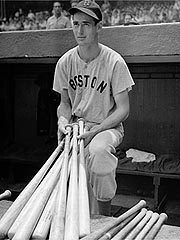
In honor of opening day, a pic of the late, great Teddy Ballgame.
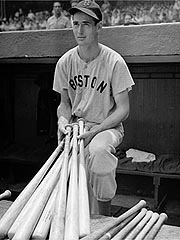
It's been a very good opening day so far. Sox beat the Rangers and the Cards pound the Phillies. The Cubs won - which sucks. Now if the damn Yankees lose tonight, it'll almost be a perfect opening day.
In honor of opening day, a pic of the late, great Teddy Ballgame.
Subscribe to:
Posts (Atom)